Edgelands: Where the Suburbs Meet the Paddocks
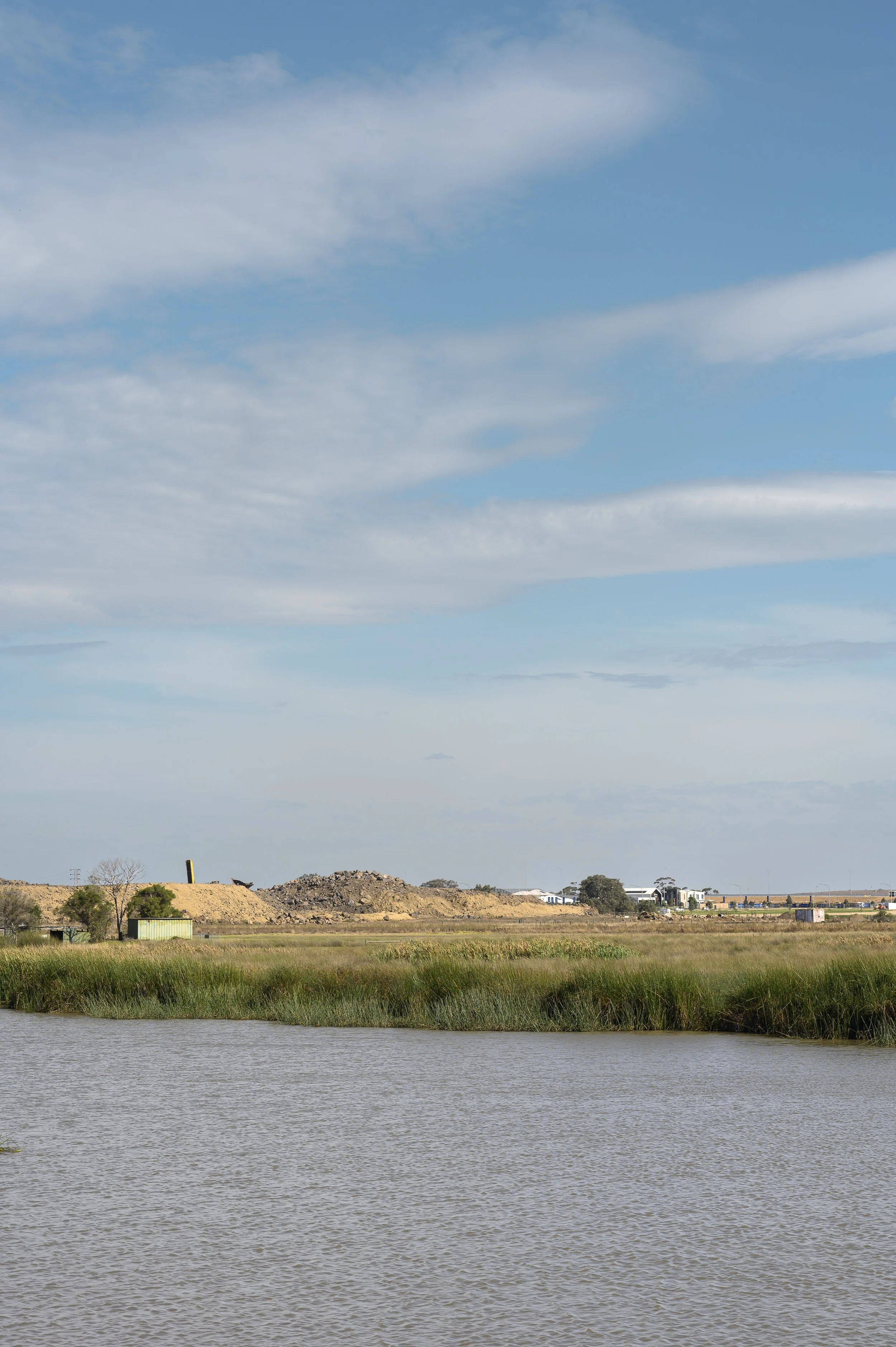
April 2025 Werribee Area
I don’t really know where I first heard the term, but I remember how strongly it resonated with the kinds of photographs I was interested in making. There’s something slightly unsettling about the concept of edgelands. It was something that slowly seeped into my mind over the course of my life; the feeling was already well formed when I began reading about it, and it really struck home.
I’ve lived in several places, including briefly in Chicago, a city I’ve returned to many times. Visits to Detroit, Berlin, Paris and Tokyo have also shaped the way I look at cities, alongside Melbourne and Auckland.
When I discovered the photographers associated with the New Topographics movement, something really clicked. I felt the same when I found Jeff Brouws, whose photographs capture so much of the feeling and aesthetic that drew me to edgelands.
I always shoot Edgelands on foot and by public transport—trams, trains and buses—often using several in a single shoot and travelling across multiple lines in one day. I often revisit the same locations. Part of my interest is in the new housing estates springing up at the ends of train lines, beyond what were once the suburban edges of the city. It’s becoming harder to see where Melbourne’s suburbs end, particularly in the directions of Ballarat and Geelong.
I’ve always avoided photographing people in my landscapes, and in these areas it’s very easy to do. There are rarely people walking the streets when I’m out shooting.
I recently discovered the work of Tom Owens, whose photographs feel like the dictionary definition of edgelands to me. There are many photographers connected to the legacy of the New Topographics, but my photographs are particularly influenced by Robert Adams and Lewis Baltz. For me, Adams captured the emptiness of the spaces he photographed. I get the same feeling when I’m floating through the edges of Melbourne. The difference is that I always work in colour.
I’m always looking for the interface between two different elements, generally something older beside something unestablished or newly formed. This is where suburbia can give way to rural farmland from one block to the next. Some roads have farmland on one side and newly built residential streets on the other. It’s pretty bleak.
I’m photographing places that people are about to inhabit. I feel a sense of expectation that little will be the same the next time I visit any of these areas. That’s part of the excitement, and perhaps part of the terror too.
With these photographs, I’m documenting the expansion of Melbourne at its coalface. This is where the real change is happening: farmland around Werribee or South Morang becomes suburbia. I think the photographs say something about Melbourne—that we’re obsessed with backyards, space and the need to have a car, and that some areas are made and defined by developers.
Some of these places feel strangely cut off—not because they are empty, but because they have been planned around roads, cars and private houses rather than walking, street life or public space. Reaching them by public transport can feel like a mission. It isn’t easy: bus waits are long, and the distances between different forms of public transport can seem interminable.
Despite the endless talk about apartments, outward suburban development remains a major part of Melbourne’s growth, with Melton one of the clearest examples. I’ve been able to make these photographs at the ends of four train lines, in four different directions from the centre of Melbourne.
These compositions are always quiet, which is generally how I make pictures anyway. It’s unusual to see people on these walks; cars are the most common way to access these areas. I’m not photographing these places to mock them. I’m interested in the short period before they become settled, when the city is still provisional and the edge is still visible.
The edge is never fixed. The estates I photograph today will eventually become ordinary suburbs, and a new boundary will emerge farther out. That is why I keep returning. The photographs are a record of Melbourne while it is still becoming.
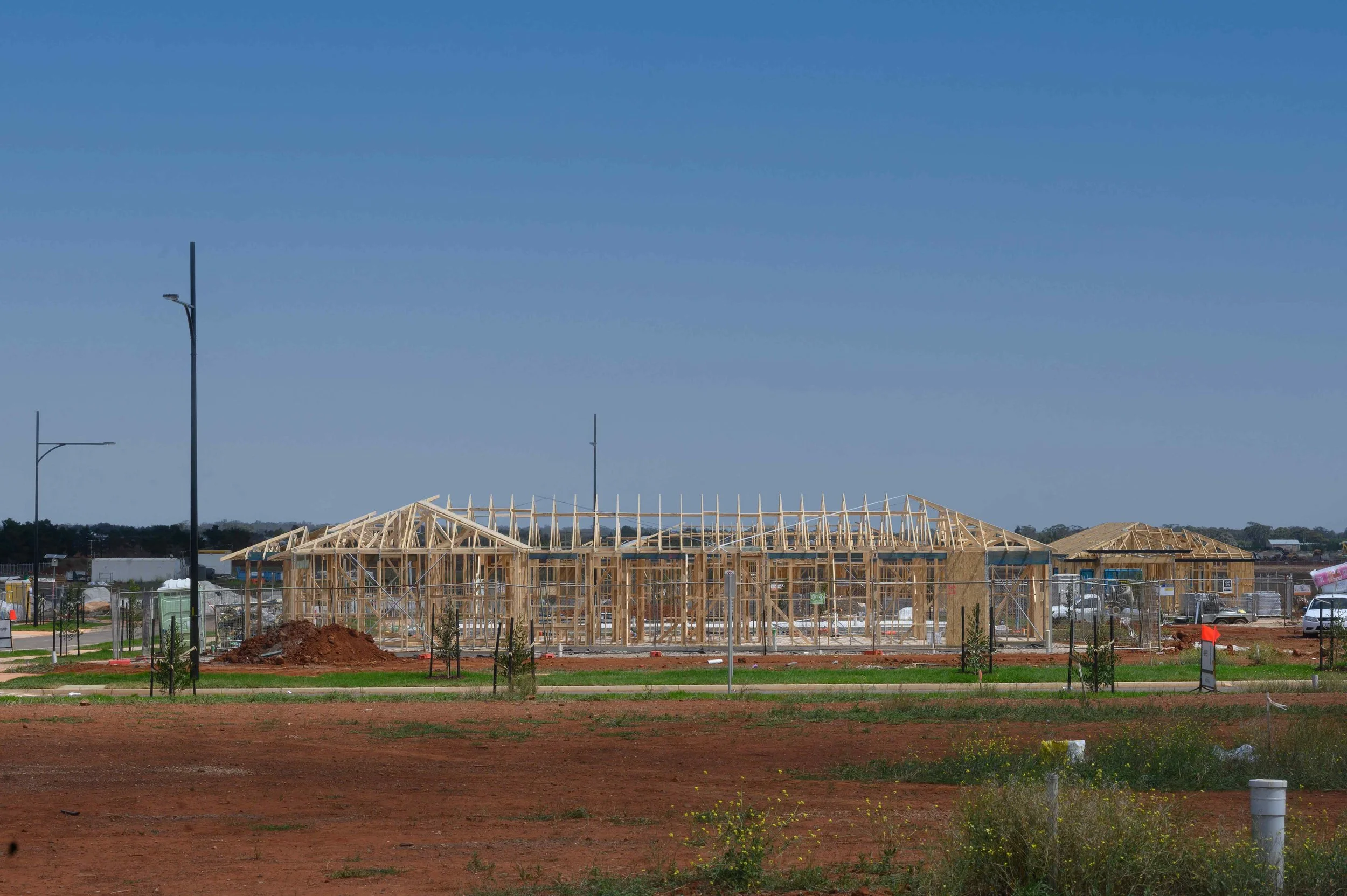
New housing construction on Melbourne’s suburban edge. These are the kinds of transitional places I return to in the Edgelands project: land between uses, before it fully becomes suburb.
