"Published by Aperture, Stephen Shore’s Uncommon Places was among the first bodies of work to push color photography beyond commercial advertising and establish it as a serious medium for the American vernacular landscape."
I can see I bought this copy in June 2016. It seems like it should have been many years before that, but I’ll trust my own hands on this one. To me, and to many, Stephen Shore is an almost mythical figure. This book is a behemoth in a number of ways - allaboutphoto.com and Blind Magazine ranked in the top ten photo books of all time not to mention how heavy the monograph is. I’ve been meaning to write this review for sometime but I’ve been rather weakened and found just looking through it to be a challenge - in a good way. The quality and weight of the paper, the quality of the reproductions are second to none. Thankfully I‘ve taken very good care of the volume in the decade since owning it, it feels like a real asset.
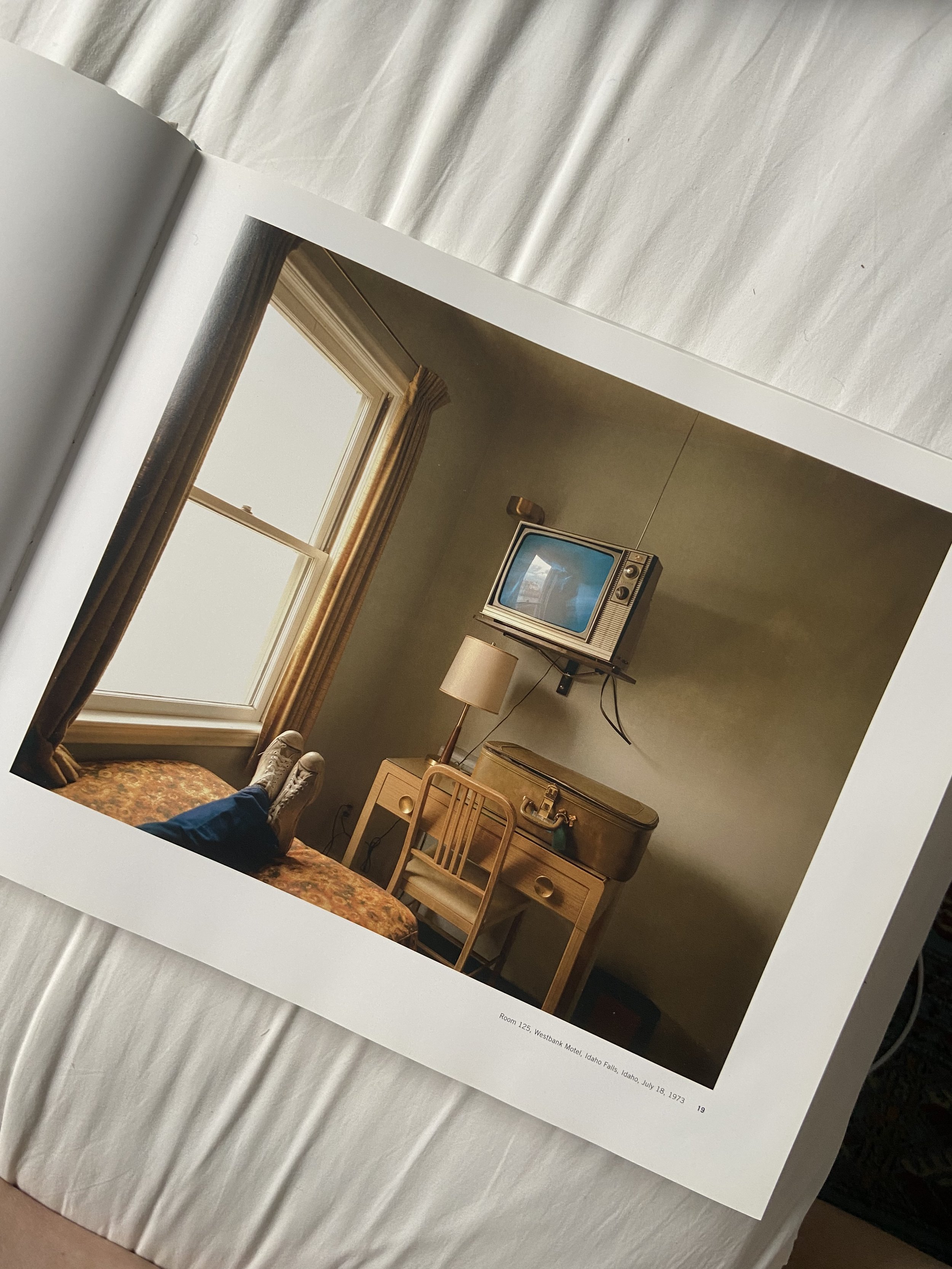
The first image (above) in “Uncommon Places” could almost have been made in our ‘selfie era’ of photography “Room 125 Westbank Motel, Idaho Falls, Idaho, July 18, 1973” Show’s Shore’s feet, a tv, lamp and a desk, beautifully illuminated through a large window, the second and third images are almost opposites - “Second Street, Ashland Wisconsin July 9 1973” and “U.S. 2 Ironwood Michigan, July 9, 1973.” (See my shot of the page below) This opening of the book sets the tone beautifully for the rest of the book - complex street scenes or landscapes set next to quiet interiors and some still life shots. It’s a really complex set of work which I have been enjoying re visiting dozens of times while writing this review. A few academics have posited that Shore was a massive influence on the Instagram aesthetic of ‘brunch photos’ and the endless stream of amateur food photos - whether or not people who shoot that kind of thing are aware of Shore is unclear but I’d agree, a good number of the photos fit well into that concept. Food photos aside, Each photo has enough going on where it forces your eye to slow down and take in all the elements, from those ‘instagram like’ shots to the much more complicated landscape shots of suburban streets.
The difference between Shore’s work and the disposability of some social media photos is that while modern feeds train us to swipe past images in a fraction of a second, Shore’s frames force the eye to stop and engage. He was consciously dismantling the visual expectations of his era—challenging the stubborn rules of what made an image worthy of being called art. We are all taught to believe what constitutes a "good" photograph; challenging this was radical in the 1970s, but it feels even more prescient in today's digital landscape. When Shore was shooting this project, treating color photography as fine art was still quite a novel concept. He is widely recognised as one of the pioneers who brought that vision to the mainstream, alongside Struth and Meyerowitz.
In the introduction Shore talks about how he has kept revisiting and re editing the work in Uncommon Places as says friends ask him why, he says he has three answers.
1)Technical - there were negatives which couldn’t be scanned in the 70’s but now they can be.
2)Logical Aesthetic - he gets less fussy as he gets older
3)Hard Truth - “I’m a terrible editor of my own work”
It’s really satisfying to see that Shore has had an exhibition featuring some of the Uncommon Places work this year in Vancouver. The fact that this work is being exhibited now in 2026 gives me great comfort and makes me want to continue working on the long term bodies of work that I’ve been making over the years.
It would be a major strike if I didn’t mention the fact that Shore was included in the landmark New Topographics: Photographs of a Man-Altered Landscape exhibition which ran between October 1975 and February 1976 - This exhibition redefined the way that landscape photography was seen and shot in the decades since, His work still adhere’s to the ideas from this exhibition - all these later and his 2023 book Topographies: Aerial Surveys of the American Landscape This style of photography is very common and appealing in the 2020’s - proving how far ahead and how influential Shore’s work still is, and continues to be these decades later.
To me most or all of the photos in the book are photos you can sit with. Partially because of the physical scale of the book, partially because most of the photos are quite complex - with many parts of the image to take in - particularly the suburbia/urban/street scenes - one of my favourites has so many different elements in it, cars, signage, people, buildings, the street, letting my eye move through the picture -Ironwood Michigan, July 9 1973 - There are so many area of interest in the image - It makes me want to try medium or large format film sometime. It could be cut. into a number of smaller more intimate scenes, but the scale or breadth of the image as it is really tells a story.
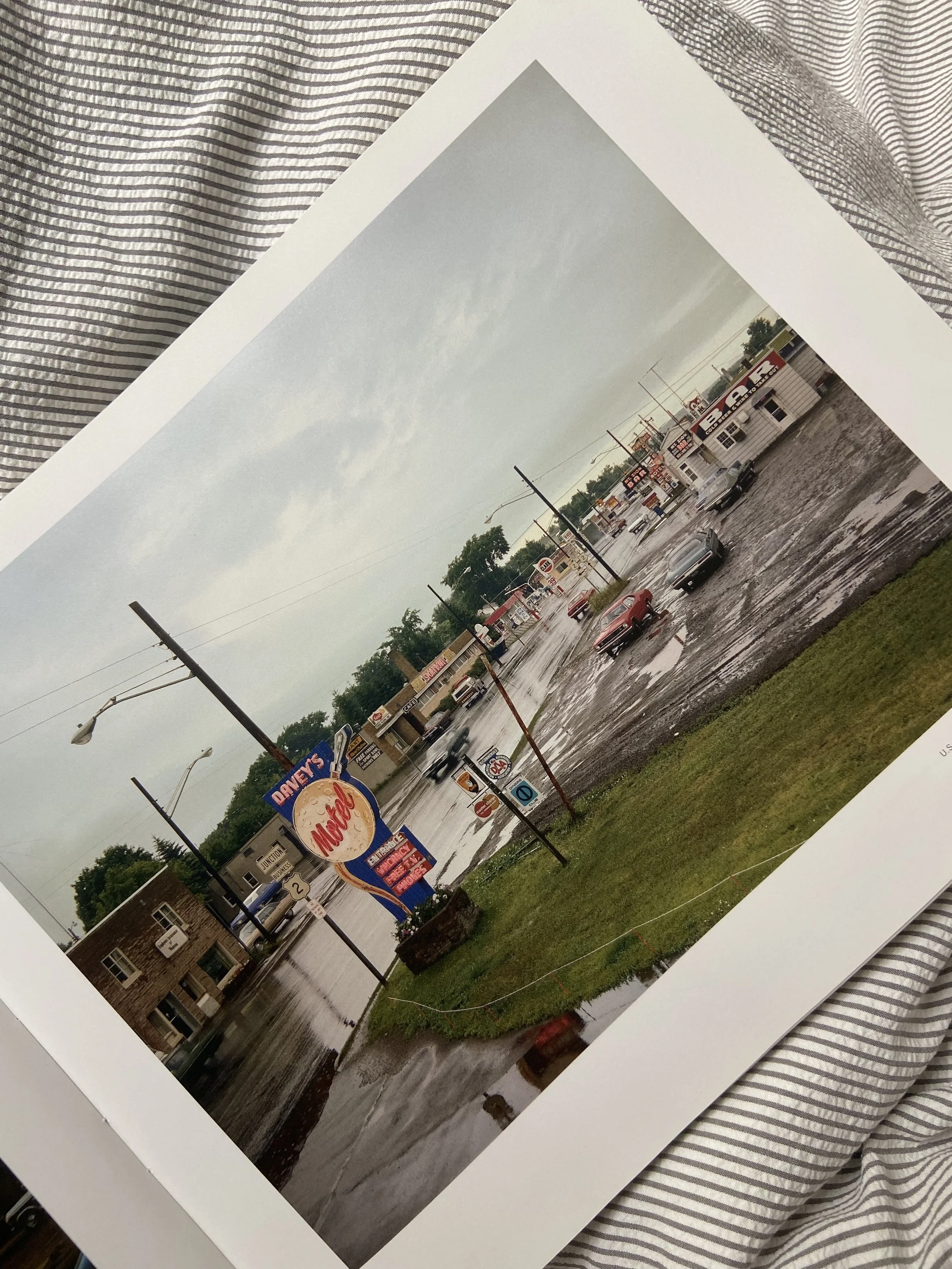
US 2, Ironwood. Michigan, July 9, 1973
The reproductions are incredible, wonderful paper which is more luxurious than many books. The large majority of the images fill the vast majority of the page - I really appreciate the framing left around the largest, it almost feels like being at an exhibition with all pages being well over A4.
Seeing Shore’s work properly and being able to really chew on it over one decade into my photographic life was a confirmation of sorts that what I was interested in - photographing the empty, slightly forlorn spaces - had some sort of value. This wasn’ the only confirmation, but I think seeing this just continually confirmed the ideas I’d seen the years before - like I mentioned in my review of Jeff Brouws some time ago - and has certainly come to mind many times when I’ve been in slightly strange locations, shooting for my edgelands project or just doing my ‘lets explore somewhere I’ve never been before on public transport” trip that I make semi - regularly.
Some of the photos are taken very close to where I’ve lived or visited over the years - page 30 - is in Battle Creek Michigan - which is an hour’s drive from Grand Rapids, where I went to high school. It somehow feels a little like home on some level, despite the years between when the images were shot, the time I lived in the area and now - there’s much that resonates with me when I look at the images again - Shore’s ability to capture an evelvate the every day in way that for me sit’s neatly between art and documentary really resonated for me from the first time I picked up the book. Shore is widely recognised as one of the people who elevated the banal - along with Eggelston,
Locations - Throwing the book open to random pages five times gave me
Maine July 20, 1974
Montana August 1974
West Virginia May 1974
Arizona August 1973
Florida March 1978
This is only five pages out of 207 - the variation a number of locations over the years Shore must have covered is staggering, I’d love to know all the routes, all the places he visited over the course of the years he shot for this specifically and how many photo’s he took before he started culling.
The variation in composition always keeps me guessing, one spread has a broad street scape in Nashville on one page, the other an almost still life image of loose light bulbs in the front window is display case of a store in Parkersburg, West Virginia.. They might have been shot two weeks apart in time and four hundred miles in distance, they seem like dramatically different pictures but they still work wonderfully together, one expansive the other tight - but they make a very satisfying pair. Other pairings 20th Street and Spruce in Philadelphia, then 21st and Spruce in Philadelphia taken on the same day are very similar pictures, with great unity.. I’m always slightly stumped by pairing images in books and making diptychs - sometimes it’s random & sometimes it dictated by place, colour, composition or other factors or even chance looking through this book, it all. makes sense - I can’t say how, but it does.
Pg 47 (pictured below) is the the same vicinity of lower Manhattan I stayed in when I was last there. I’m sure a good number of people would be able to cross over image locations in this book with their lives somehow. The number of miles that Shore drove on the trips which he photographed the material for the book must have been staggering - the what I can find about the dates etc was “a number of trips between 1973 and 1979” (according to the International Centre for Photography)
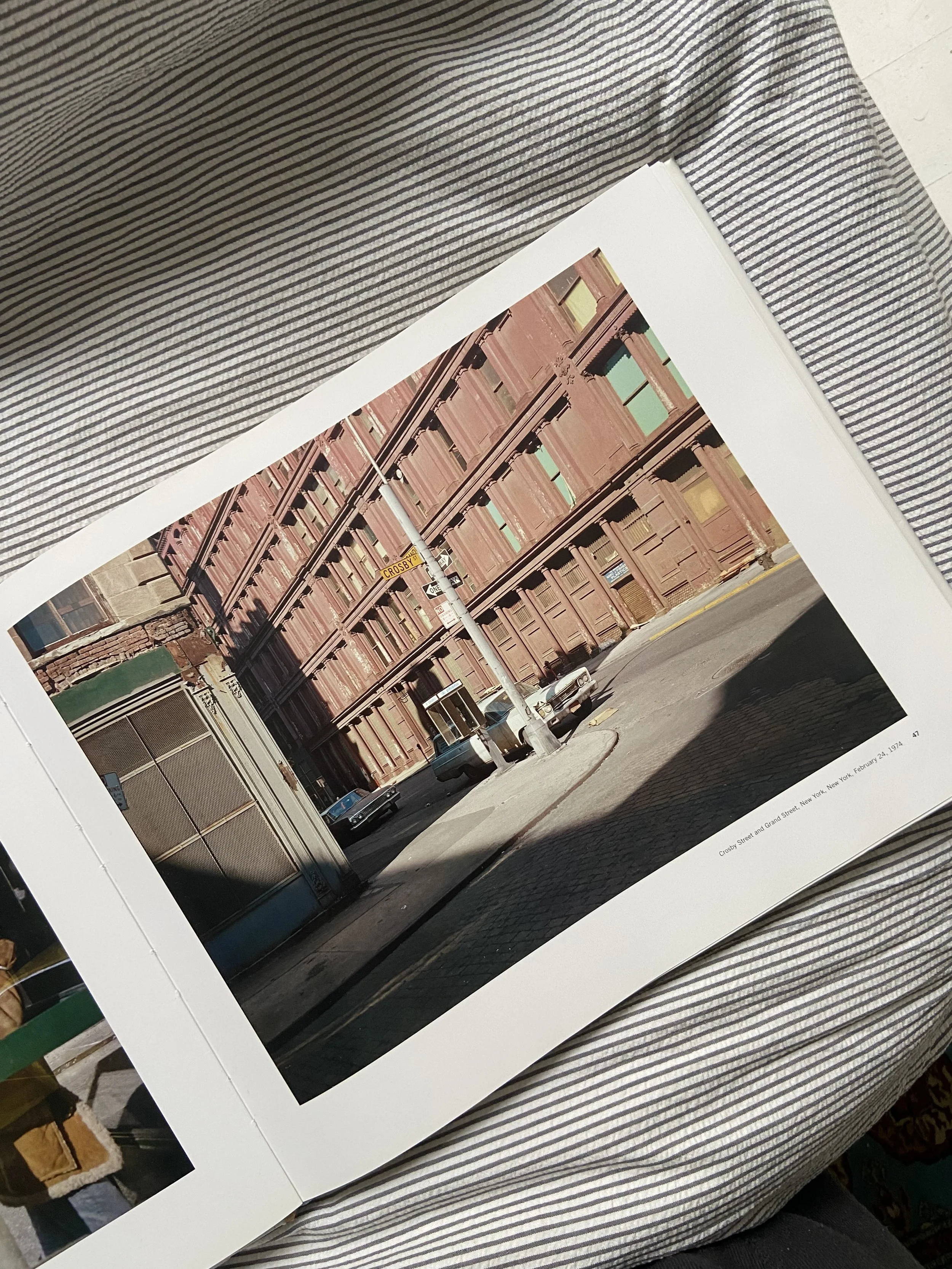
Crosby & Grand Street, New York, New York. February 24, 1974.
It’s really satisfying to see that Shore has had an exhibition this year in Vancouver - featuring work from the Uncommon Places book. The fact that this work is being exhibited now in 2026 makes gives me great comfort and makes me want to continue working on the long term bodies of work that I’ve been making over the years.
It would be a major strike if I didn’t mention the fact that Shore was included in the landmark New Topographics: Photographs of a Man-Altered Landscape exhibition which ran between October 1975 and February 1976 - This exhibition redefined the way that landscape photography was see and shot in the decades since, His work still adheres to the ideas from this exhibition - all these years later and his 2023 book Topographies: Aerial Surveys of the American Landscape This style of photography is very common and appealing in the 2020’s - proving how far ahead and how timeless and influential Shore’s work still is these decades later.
Further Reading, Links & Background
The best place to see the work online is on Shore’s website - http://www.stephenshore.net/m/uncommon.php
The Photographic Eye on You Tube was very helpful for this review:
This interview with Stephen Shore is excellent.
Stephen Shore: Uncommon Places at the Vancouver Art Gallery
An interesting chat Shore had with Gregory Crewdson in 2020
Andrew Wurster is a documentary photographer working across Melbourne and regional Victoria, documenting the quiet vernacular of Australian streetscapes and edgelands. You can view current portfolio series and archival editions in the Melbourne Fine Art Print Store
See long term projects and curated galleries: https://www.wurstercreative.com/locations-themes
